If you’re searching for your next mermaid book for teenagers, one that goes far beyond glitter tails and surface-level romance, Mermaid Princess Amelia offers a layered, emotionally rich dive into an epic mermaid fantasy series. Across the pages of “Mermaid Princess Amelia and the Lost Symphony,” “Destiny’s Theater,” and the “Stories from the Undersea World of Mermaid Princess Amelia” volumes, readers encounter a fully realized underwater fantasy civilization—complete with diverse mermaid clans, ancient mermaid kingdoms, and tangled mermaid bloodlines.
This is not just a mermaid love story or a coming of age mermaid book—it’s a saga of mermaid diplomacy, mermaid war, and the fragile balance between mermaid factions and the mermaid council. The mermaids themselves vary wildly in appearance and temperament, from sea fairy-like scholars with lemon hair to tattooed warriors with chocolate-toned skin. Some are gentle, others feral. The series doesn’t shy away from dark mermaid stories, piracy, or the emotional toll of conflict, making it a standout among ya mermaid romance books and fantasy mermaid books.
The merfolk’s bond with sea creatures is equally compelling. From Saliffa’s rusty parrotfish to Lampros’ ink-trailing cuttlefish, mermaid animal companions are woven into the story’s emotional core. These aren’t just pets—they’re reflections of the mermaids’ inner lives, echoing animals associated with mermaid legends and the lore explored in the mermaid documentary Animal Planet. If you’ve ever wondered what pets do mermaids have, or what animal inspired mermaids, this series offers poetic, character-driven answers.
Whether you’re drawn to mermaid books for young adults, fantasy romance mermaid books, or real mermaid stories with mythic depth, Maxine Foti’s work—available for free mermaid books online via Hasalynx Press’ digital library—is a must-read. And if you’ve already begun your journey with Amelia, you’ll want to explore more about the mermaid race, their relationships with sea animals, and the intricate mermaid society that governs their world. Dive deeper below.
The Comprehensive Mermaid Race FAQ: From Global Myth to the World of Mermaid Princess Amelia
Q: Are mermaids real? Have they ever existed?
In our world, the question are mermaids real often leads to tales of sailors mistaking manatees for mythical sea maidens. So while the answer to is mermaids real or was mermaids real is biologically no, the fascination endures. Historical sightings and legends have fueled centuries of speculation about why mermaids exist, why mermaids are not real, and even why mermaids could be real—especially in cultures where the ocean itself is seen as sacred and mysterious.
But in the fantasy universe of Mermaid Princess Amelia, mermaids are not folklore—they are a fully realized civilization. The series explores what it would mean if mermaids truly lived among us. With kingdoms like Antemidia in the Caribbean and Nerland in the Baltic Sea, the story imagines why mermaids are real in a parallel underwater society rich in culture, politics, and ancestral magic. These merfolk have economies, councils, and conflicts that mirror our own, making readers wonder: have mermaids ever existed, and will mermaids ever exist in some hidden realm beneath the waves?
In Amelia’s world, the answer is a resounding yes.
Q: Why do people believe mermaids could be real?
Belief stems from centuries of compelling global folklore and humanity’s fascination with the ocean’s unknown depths. In the world of Mermaid Princess Amelia, this belief is justified, as human encounters with mermaid kingdoms, especially during the Antemidian “Coastal Season” where they engage in piracy using their magical abilities like hypnotic singing to lure ships onto rocks, confirm their existence and fuel legends throughout human history.
Q: Will mermaids ever exist in reality?
As biological creatures, it remains highly unlikely due to evolutionary constraints. However, their stories and symbolic power will continue to thrive in human culture, much like they do in the intricate and lived-in world of Mermaid Princess Amelia‘s adventures across various undersea kingdoms.
Q: Are mermaids mammals? What is their biology?
In reality, mermaids are a biological impossibility—a hybrid that defies scientific classification. The question are mermaids mammals or would mermaids be cold blooded sparks endless debate among fantasy enthusiasts and marine mythologists. Some wonder would mermaids be amphibians, or do mermaids need air like humans. But in the richly imagined world of Mermaid Princess Amelia, mermaids are a distinct magical species with their own biological logic.
These merfolk possess both gills and lungs—yes, do mermaids have gills, does mermaids have gills, and would mermaids have gills are all answered here. They can breathe underwater and breathe on land, making them uniquely adapted to life in both realms. Despite their aquatic nature, they’re not classified as mammals in the traditional sense, though would mermaids be mammals is a fair question given their human-like traits.
Mermaids in this series have belly buttons—so yes, do mermaids have belly buttons and would mermaids have belly buttons are confirmed. They also have a wide range of appearances: would mermaids have hair? Absolutely. Would mermaids have dark skin? Yes, the series celebrates diversity in tone, texture, and form. And would mermaids be fat? Some are curvy, some lean—just like humans, their physiques vary based on genetics, lifestyle, and environment.
So while can mermaids drown might seem paradoxical, the answer in Amelia’s world is nuanced. Their dual respiratory system makes them resilient, but not invincible. This is fantasy biology at its finest—an imaginative answer to can mermaids exist that invites readers to suspend disbelief and dive into a world where magic and anatomy coexist.
Q: How do mermaids breathe? Can they drown?
In the world of Mermaid Princess Amelia, mermaids use their gills to breathe underwater and their lungs to breathe on land, whether in their mermaid or human form. This dual respiratory system makes them incredibly adaptable and means the concept of drowning as it applies to humans does not directly apply to them, as they can extract oxygen from both water and air through their specialized biological systems.
Q: How are mermaids born? Do they lay eggs?
The reproductive biology of mermaids in Mermaid Princess Amelia remains partially veiled in mystery, adding to the allure of their species. While the novels do not explicitly detail how mermaids are born or how mermaids reproduce, the presence of advanced medical infrastructure—such as hospitals and doctors in Destiny’s Theaters—suggests a highly evolved society with systems in place to support health, childbirth, and family life.
Though it’s never confirmed how mermaids have babies or how mermaids give birth, the implication is clear: mermaids likely follow a mammalian-style reproductive process. The existence of prenatal care and emotional support networks hints that can mermaids get pregnant and can mermaids have babies are both true within the logic of the series. The absence of references to spawning or egg-laying makes do mermaids lay eggs, does mermaids lay eggs, and would mermaids lay eggs unlikely in Amelia’s world.
As for who do mermaids mate with, relationships in the series are emotionally complex and often cross cultural or political boundaries, reflecting the depth of merfolk society and its nuanced approach to love, lineage, and legacy.
Q: Who do mermaids mate with?
Mermaids in the Mermaid Princess Amelia universe primarily form relationships and mate within their own complex societies and kingdoms. The series explores these social structures in depth, showing a civilization with its own norms and customs across different undersea realms, with characters navigating intricate social hierarchies and relationships. However, mermaids can date humans, too, as shown in the case of Mermaid Sawa and her human boyfriend Wiktor. Check this related article on the topic: Do humans know about the mermaids’ existence in the “Mermaid Princess Amelia” series?
Q: Are mermaids evil or dangerous?
In Mermaid Princess Amelia, the question are mermaids evil or are mermaids dangerous doesn’t have a simple answer. Much like humans, mermaids in this mermaid fantasy series display a wide range of behaviors, beliefs, and emotional capacities. Most are not inherently violent—they do not kill humans, eat people, or kill sailors without cause. So while some may wonder is mermaids evil or is mermaids dangerous, the truth is far more nuanced.
That said, the kingdom of Antemidia presents a chilling exception. During their “Coastal Season,” Antemidian merfolk engage in piracy, using hypnotic singing to lure ships onto rocks—a haunting echo of siren lore. In this context, can mermaids kill you or will mermaids kill you becomes a real threat. The series also introduces feral mermaids, tragic figures who have lost their ability to sing and speak, driven by isolation into madness. Princess Amelia herself survives a brutal encounter with one, raising questions like did mermaids kill sailors or did mermaids eat sailors in this world.
So why mermaids are dangerous or why mermaids are evil depends entirely on the society, the individual, and the circumstances. If you’re intrigued by this darker side of merfolk lore, check out our full article on are mermaids dangerous—where we dive deeper into the psychology, politics, and survival instincts of the mermaid race in Mermaid Princess Amelia. From feral mermaids to pirate kingdoms, this deep-dive explores what makes some merfolk lethal, and others heartbreakingly misunderstood.
Q: What do mermaids look like?
In Mermaid Princess Amelia, mermaids are anything but uniform. Their appearances reflect the cultural richness of their underwater civilizations, offering a vivid answer to questions like how mermaids look, what mermaids really look like, and how mermaids would actually look in a fully imagined fantasy world.
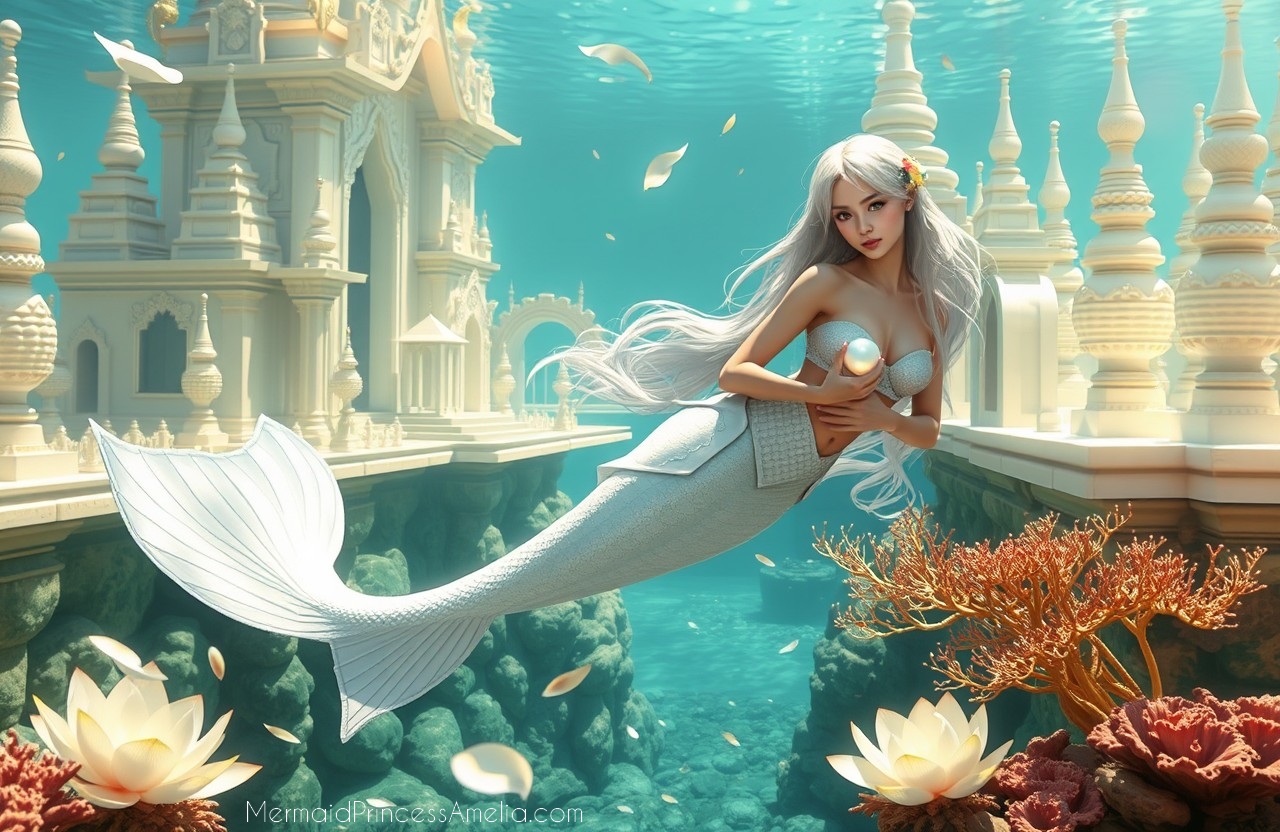
Tail colors often mirror hair tones, creating striking visual harmony. Eye colors range from storm-gray to coral-pink, and hairstyles vary from sleek braids to wild curls. Fashion is equally diverse—some mermaids wear ceremonial face masks, others adorn themselves with minimalist ornaments or removable tattoos. These stylistic choices aren’t just aesthetic; they’re deeply tied to regional identity. Mermaids from Antemidia, for example, embrace bold Caribbean influences, while those from Nerland reflect Baltic restraint and elegance.
If you’re curious to explore how mermaids look in real life within the logic of fantasy, or want to see what mermaids would look like across different kingdoms and bloodlines, we invite you to read our dedicated article on the mermaids’ and mermen’s looks in the Mermaid Princess Amelia series. It’s a deep dive into the beauty, symbolism, and storytelling behind every scale and strand.
Q: Can mermaids turn into humans and live on land?
Yes, in the Mermaid Princess Amelia universe, mermaids can turn into humans by magically transforming their tails into legs, allowing them to walk on land and interact with the surface world. However, as character Darren Klar notes, can mermaids live on land long-term is a complicated question—their physiology and emotional connection to the ocean make permanent land life difficult and often disorienting.
Mermaids possess two distinct types of voices: their everyday speaking voice and the enchanting mermaid voice—a magical form of song. So yes, do mermaids sing? Absolutely. Their songs carry potent magical energy, capable of hypnosis, emotional influence, and even commanding sea creatures. These abilities are not universal, though—does mermaids have powers depends on their lineage, training, and kingdom. Some mermaids inherit intuitive gifts, while others study formal magic tied to ancestral rituals and regional traditions. Check out this article to learn more: Mermaid magic in the “Mermaid Princess Amelia” fantasy series.
This blend of transformation, voice magic, and intuitive power makes the merfolk of Amelia’s world one of the most compelling magical races in modern fantasy.
Q: What do mermaids eat and drink? What do they do?
The diet in Mermaid Princess Amelia reflects the rich cultural diversity of mermaid societies and offers a flavorful glimpse into what mermaids eat and what mermaids eat and drink across different regions. From Jet Mir’s underwater meals of naan bread and grilled fish—yes, do mermaids eat fish—to Portia’s algae salad and mussel noodles prepared in her geometric icosahedron home, food is both sustenance and cultural expression.
Even in harsher settings, like the mausoleum prison, mermaids survive on seagrass, algae species, and farmed oysters, showing how diet adapts to environment and status. On land, mermaids indulge in human delicacies: Amelia adores breadsticks, Edith savors chocolate cake, and Tikalie is obsessed with ice cream. These moments of culinary joy bridge the gap between ocean and surface life, revealing what mermaids do when navigating both worlds.
Curious about the full spectrum of merfolk cuisine and daily rituals? Dive into our article exploring mermaid food culture, lifestyle, and the symbolic meaning behind what they eat.
Q: Where do mermaids come from and live?
In Mermaid Princess Amelia, mermaids originate from a vast network of global undersea kingdoms, each with its own distinct traits, customs, and mythological lineage. If you’ve ever wondered where mermaids come from, this series offers a compelling answer rooted in fantasy world-building. From the warm currents of Antemidia in the Caribbean to the icy depths of Nerland in the Baltic Sea, the story explores which ocean do mermaids live in and how geography shapes their societies.
Their belief systems are equally diverse. Which mythology are mermaids from depends on the region—some kingdoms worship polytheistic pantheons, while others follow state-sanctioned deities or ancestral spirits. China Sea mermaids like Huang Yan and Guo Guiying, for instance, are said to descend from dragons, blending aquatic lore with Eastern mythic traditions. Other bloodlines may trace their origins to sea serpents, sirens, or elemental beings, creating a rich tapestry of merfolk ancestry.
So where mermaids live in this universe is not just a matter of location—it’s a reflection of culture, magic, and history. To explore the full scope of mermaid heritage, mythology, and regional identity, dive into our article on merfolk origins and belief systems in Mermaid Princess Amelia.
Q: Which language do mermaids speak?
Mermaids in Mermaid Princess Amelia are often polyglots, reflecting their deep cultural ties and diplomatic exchanges with human civilizations. They speak a wide range of languages, including Spanish in the Caribbean kingdoms, Georgian in the Black Sea (as spoken by Edith Dvali), and Arabic and ancient Egyptian/Coptic in the Nile-based Lotus State (used by Nubia). In addition to these human languages, mermaids also communicate in their own ancient tongues like Ancient Antemidian, and a common trade language called Oceanian—essentially the mermaid language equivalent of English, used across kingdoms for commerce and diplomacy.
So if you’ve ever wondered which language do the mermaid speak, this series offers a rich linguistic tapestry that mirrors the diversity of its characters and settings. To explore the full scope of mermaid languages and how they shape identity and culture in the series, check out the detailed article on language diversity across characters from Mermaid Princess Amelia and the Lost Symphony
Q: Are mermaids and sirens the same?
The Mermaid Princess Amelia series thoughtfully explores the mythological confusion surrounding mermaids and sirens. In classical Greek mythology, they were entirely separate beings—are mermaids and sirens the same? Historically, no. Sirens were bird-like women whose songs lured sailors to their doom, while mermaids were sea-dwellers with a more romanticized image.
The series bridges this gap by introducing “feral mermaids”—tragic, dangerous figures who have lost their voices and sanity. These beings embody the fearsome traits sailors once attributed to sirens, offering a chilling reinterpretation of why are sirens depicted as mermaids in modern lore. Meanwhile, the “normal” mermaids in Amelia’s world are morally complex, emotionally layered, and far from one-dimensional, creating a rich tapestry that honors both myth and original fantasy.
Q: What do Mermaids Symbolize?
In the world of Mermaid Princess Amelia, mermaids powerfully symbolize the experience of crossing borders and living between two worlds. They represent the struggle of navigating the complexities of belonging to two distinct cultures—the human and the mer—and the identity that comes from that duality. Through Princess Amelia’s journey and the various mermaid characters, the series explores themes of cultural hybridity, the tension between different worlds, and the search for identity when one belongs to multiple realms simultaneously, making them potent symbols of cultural negotiation and personal transformation.
Q: What are some Trivia about Mermaid Race?
If you are curious about the mermaid race in Mermaid Princess Amelia and the Lost Symphony, check out this article with 10 trivia about it. You’ll love it!
Mermaids, Mermen and their Relationship with Sea Animals
In the immersive underwater realm of Mermaid Princess Amelia, mermaid animals are more than background creatures—they’re emotional companions, symbols of lineage, and reflections of the sea’s living magic. From coral grottos to deep trench fortresses, merfolk are often seen with mermaid pets alive, forming bonds that mirror human-animal relationships but with a distinctly oceanic twist.
Mermaids and their Undersea Pets
Saliffa, a mermaid mathematician, keeps a rusty parrotfish named Delta—a quirky mermaid animal companion known for its stubborn loyalty and shimmering scales. Lampros shares his courtyard with Parmenides, a cuttlefish whose ink trails are said to resemble ancient runes. General Aalona, a battle-hardened strategist, is rarely seen without her hermit crab, a creature that’s survived more campaigns than most soldiers. You can click here to read a separate article about mermaids interacting with sea animals in the Mermaid Princess Amelia book series.
Sea Animals and Monsters Mermaids Fear
While mermaids in Mermaid Princess Amelia are powerful and intuitive, they’re not without fear. Deep-sea predators like abyssal eels, spectral jellyfish, and the elusive lionfish haunt the darker regions of the ocean, especially near prison reefs and uncharted trenches. These fears shape their rituals, migration patterns, and even political alliances. Curious about the full list of creatures mermaids avoid and how these fears influence their world? Read our article on animals mermaids are afraid of to dive deeper into the lore.
The Epic Fantasy Society in Mermaid Princess Amelia Novel Series
Mermaid Kingdoms, Underwater Fantasy Civilizations and Undersea Cultures
The underwater realm of Mermaid Princess Amelia is a sprawling mermaid epic fantasy world, where ancient mermaid kingdoms, noble bloodlines, and political intrigue shape every tide. This underwater fantasy civilization is home to diverse mermaid clans, each with distinct mermaid ancestry, mermaid culture, and sacred mermaid rituals. From the fish mermaids of the turquoise sands in Antemidia to the mermaids of the turtle island in Hainan, the series introduces a rich tapestry of mermaid fantasy races and the mermaid fantasy society they inhabit.
Related Article: Cultural Diversity in “Mermaid Princess Amelia and the Lost Symphony” by Maxine Foti
Mermaid Royal Families, Nobility, Diplomacy and Wars
At the heart of this world lies the mermaid royal family, including Queen Marzia Mond and Princess Lumina Mond, whose lineage is central to the realm’s shifting power. The brutal mermaid war between Caribbean and Azorean Atlantis—known as the Atlantis² War—left scars across generations, fueling ongoing mermaid fantasy conflict and reshaping mermaid politics. Figures like Hai Yao, a skilled diplomat from the South China Sea, navigate delicate mermaid diplomacy, while the mermaid council and Antemidia’s council of generals enforce evolving mermaid society rules.
Mermaid Mythology and Religion
Religious life is equally layered, with mermaid mythology and mermaid religion ranging from shamanic rites to the state-sanctioned Antemidian pantheon. Noble houses like Macy’s uphold tradition, while scattered mermaid tribes and rival mermaid factions challenge the old order. This is not just a tale of sea creatures—it’s a saga of power, legacy, and survival beneath the waves.
More Articles about Mermaid Society in Mermaid Princess Amelia Books
If you’ve already fallen in love with the richly layered world of Mermaid Princess Amelia, there’s so much more to explore beyond the main storyline. Our mermaid books dive deep into the intricacies of merfolk society—from the nuanced roles of mermen in The Lost Symphony and the story collections, to the wisdom and emotional depth of elderly mermaid characters who shape the cultural memory of the underwater kingdoms. Curious about representation? We also explore LGBTQIA+ mermaids (lesbian / sapphic mermaids and gay mermen) and how identity flows through the currents of mermaid life.
For those fascinated by mermaid governance and structure, articles on CONCH, TUNA, and other undersea organizations reveal how power and diplomacy operate beneath the waves. And if you’ve ever wondered how mermaids measure time, our breakdown of the undersea time system offers a glimpse into the mermaids’ daily rhythms and rituals.
✨ You can click here to browse all articles from the Mermaid Society category—especially recommended for readers of mermaid fantasy books, YA mermaid novels, and anyone seeking fresh insights into the lore behind the series. We update regularly, though some of the newest articles may only be visible in the category view
Click here to browse all articles from the Mermaid Society Category (highly recommended – we do our best to update pages as often as possible, but some of the newest articles will be visible only in the category).