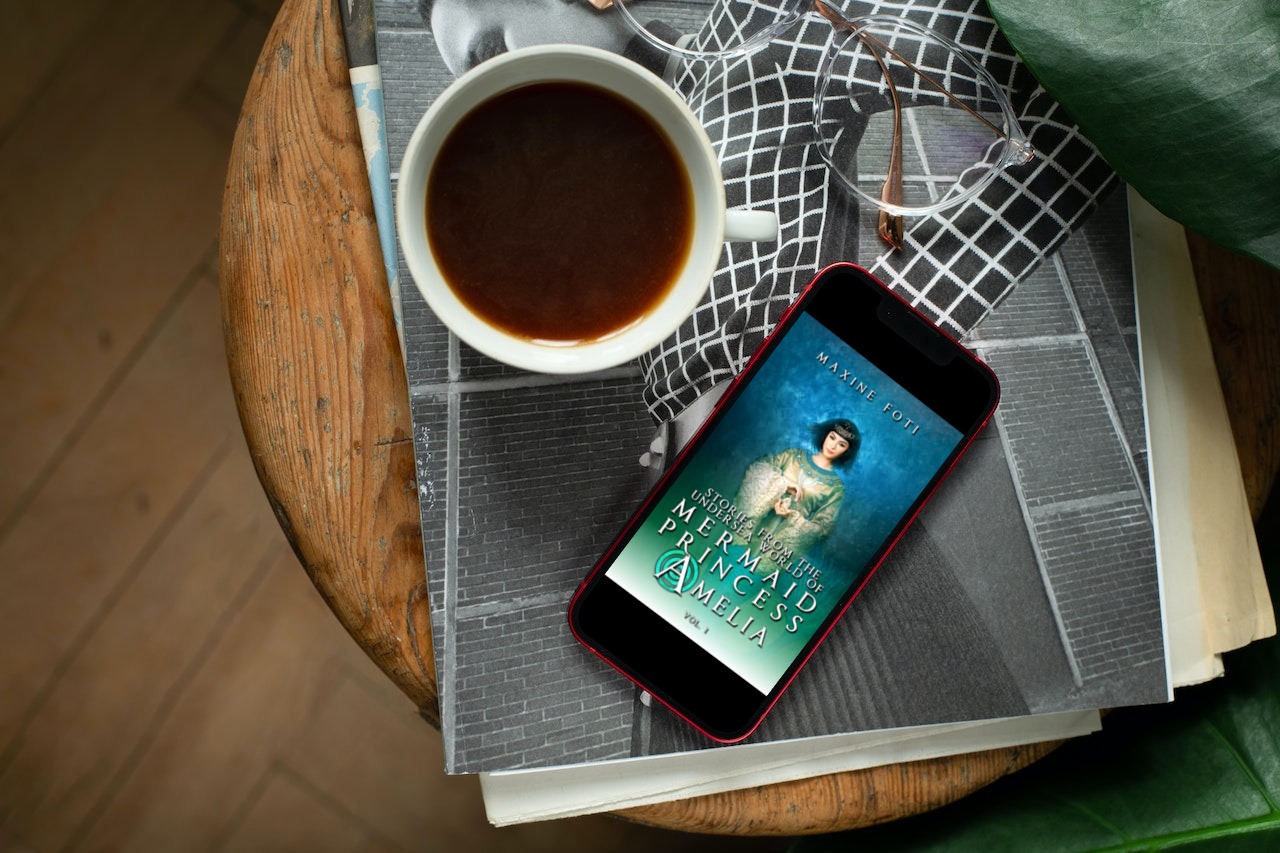
“Stories from the Undersea World of Mermaid Princess Amelia, Vol. 1” is a story collection by Maxine Foti, one which has just been released (15.12.2022). Just like the first novel from the Mermaid Princess Amelia fantasy series, it is a complex and multifaceted work, one that takes the reader on a complex journey around several mermaid kingdoms. In this editorial review, you can learn more about the collection’s strengths, and learn if it’s going to be an enjoyable read for you.
Editorial review “Stories from the Undersea World of Mermaid Princess Amelia, Vol. 1”
The Basics
To start with, the collection contains eight stories that further develop characters which have already appeared in “Mermaid Princess Amelia and the Lost Symphony.” It also takes the reader to mermaid kingdoms that they already read about, so that they can enjoy exploring them. There is, however, much novelty: a cast of over seventy characters, and over fifteen new mermaid kingdoms.
The Mermaid Kingdoms
The stories are all written with much detail, and color. Like it quickly turns out, the mermaid kingdoms in Amelia’s world – at least those close to the shore – are inspired by the world’s most remarkable civilizations. Readers have already seen it partly in the Lost Symphony, where Antemidian culture draws a lot from the Mayans, Lotus State culture – from Egyptians, and the Honey Earth culture – from Indians. However, readers only now have a fuller view of the remaining countries: Black Sea turns out to be inspired by the Ottomans, Delshad – by Persians, and Argolic Gulf – by Greeks. Interestingly though, the country of the mermaid princesses from the Southern Baltic, Sawa and Mewa, seems to be inspired not by the beginnings of the Polish state but by the later period dominated by baroque and rococo.
After pointing this out, one may be tempted to ask whether the stories are innovative in any way, then, or whether the author just took an easy way out. The answer is, the stories are innovative – and that’s because facts borrowed from history are highly selective and thoroughly mixed with new ideas and details from the undersea world.
It is thus safest to say that most mermaid kingdoms (located close to land) borrow architecture, art, and language from humans, but not (always) religions, holidays, or customs. For example, Honey Earth has a real-world religion (Shivaism), but the Black Sea has no belief at all, and Delshad has a fictional faith (Heart of the World).
The collection also brings much new information about how the mermaid society works. Once again, we learn about alliances and unions between countries (e.g., Antemidia – Ancora, Caspian Sea – Delshad) and institutions located in the ocean (mostly scientific ones). Particularly interesting are the fragments about the lives of mermaids and mermen from the Argolic Gulf, as they describe subjects taught at an underwater school. For fans of all things steampunk, there is also some information about undersea inventions and jobs.
The Characters
But what about the heroes of the collection? To put things simply, despite scales and glitter, the collection characters are very complex and human inside, torn between their immediate duties and their heart’s desires. Everyone, young and old, has some lessons they must learn and some challenges they must face. This makes the collection appeal to different age groups, which is definitely a strength.
Continuing the topic of characters: some may be seen as controversial by some readers, because they appear to walk the thin line between good and evil, often making choices that may seem wrong, but for them, are essential, as they help them express and deal with the emotions that they feel. Tikalie’s seemingly mindless choice to resign or Nubia’s controversial decision to choose a fear deity as a patron, are both great examples.
In the collection, many characters seem to be searching for their happiness, as well. After leaving their homes, both Sawa and Jet Mir needed to rebuild their identity, which was difficult for them. The same happened to Saliffa, whose dreams crashed after she had to change her plans at the last minute.
Intriguingly, there’s also a lot in this collection, about the suffering of young people. The burden of expectations given by teachers and parents, criticism, a feeling of being “not good enough” or an outsider, and even domestic violence, are all among the many complex topics that the collection touches on, which will feel familiar to many readers.
The Relationships
The collection is an extended essay on human relationships, as well, one that speaks volumes about family, friendship, romance… but not only. A significant motif is the student-teacher relationship, or rather, adept-mentor relationship. Amelia-Asvald, Jet Mir-Jetesh, and Mewa-Anastazja are all relationships in which a young person is, in a sense, shaped by their mentor, who are a great inspiration.
But let’s give friendship and love some more space in this editorial review, as they are important elements of both stories. Maxine Foti describes friendship as an emotion binding for life, one that arises unexpectedly even between very different people. There are few novels where friendship is considered equal to love; usually, it is love that gets discussed most. But, in this mermaid collection, there are really beautiful friend pairs, such as Edith-Mariam or Ehsan-Hassan.
As for love, it is presented in many different ways. There are long-term and successful relationships among the older characters, such as Asvald-Ulyssa, or Darya-Parviz. However, there are also broken marriages, such as Anastasia-Roman, or Shri-Mir-Lohita-Mia. Then, among young adult characters, there are relationships based on common interests and physical attraction, such as Sawa-Wiktor or Saliffa-Ehsan, obviously described with their share of difficulties. And last but not least, there are also first crushes and arguments, among young couples such as Nubia-Setenet and Poseyda-Vasilakis. So once again, no matter what the reader’s age and level of experience is, they will find something interesting to read about.
The Plot
As for the collection’s plot – because that’s something you are all probably very interested in – it’s fair to say that all stories offer great insight into the characters’ lives underwater, so they can be collectively described with the genre of fantasy and slice of life. However, each story has its own separate plot, one drawing from many genres simultaneously. To give you a couple of examples, Tikalie’s story is a mix of court life, travel, and romance; but Edith’s story, is about family, friendship and art, and Nubia’s story – about adventure, danger, and ancient magic, with a surprising sci-fi twist that most readers definitely wouldn’t expect.
In addition, most stories show traits of other literary genres, such as drama and comedy. Some passages are very sad; others are extremely funny. Overall, the collection is so extensive and packed with all sorts of interesting subplots that there’s plenty to talk about – and that’s why people are talking!
The Verdict
Having said all this, “Stories from the Undersea World of Mermaid Princess Amelia, Vol. 1” is a story collection that’s definitely well thought through and executed. It is perfection from literary point of view, and an incredibly entertaining, enriching read. If you haven’t picked a copy yet, now is the time.

Grab your copy of “Mermaid Princess Amelia and the Lost Symphony” here:
English: https://www.amazon.com/dp/B08T6BJ6RG
Spanish: http://www.amazon.com/gp/product/B08Z8GK1JX
Italian: https://www.amazon.com/dp/B0953PN3Y7
…and a copy of “Stories from the Undersea World of Mermaid Princess Amelia, Vol. 1” here:
English: https://www.amazon.com/dp/B0BPM2JKMZ



Leave a Reply