
Ancient Greece with its lands, mountains and seas, was always a fertile ground inspiring stories of all kinds. The Greeks believed in a wide variety of creatures, many of which were inhabitants of the waters: sea monsters such as the fearsome Ceto, Scylla or Charybdis, ferocious beasts destroying ships and above all, also mermaids.
Countless local myths mention mermaids, defining them as sensual and seductive women endowed with a hypnotic, melodious voice capable of making anyone who listens precipitate into total perdition.
This is the case narrated in Homer’s Odyssey where, on his dangerous way back home, King Odysseus is forced to pass near Antemoesa, the island of the sirens. To save his oarsmen from death, Odysseus plugs their ears with wax and orders them to tie him to the mast of the ship, so that he can hear the beautiful songs without getting lost.
Another myth that we need to look into, when looking at the Greek mermaids, is that of Orpheus, Jason and the Argonauts, where the former saves the crew by playing lyre to drown out the sirens’ songs.
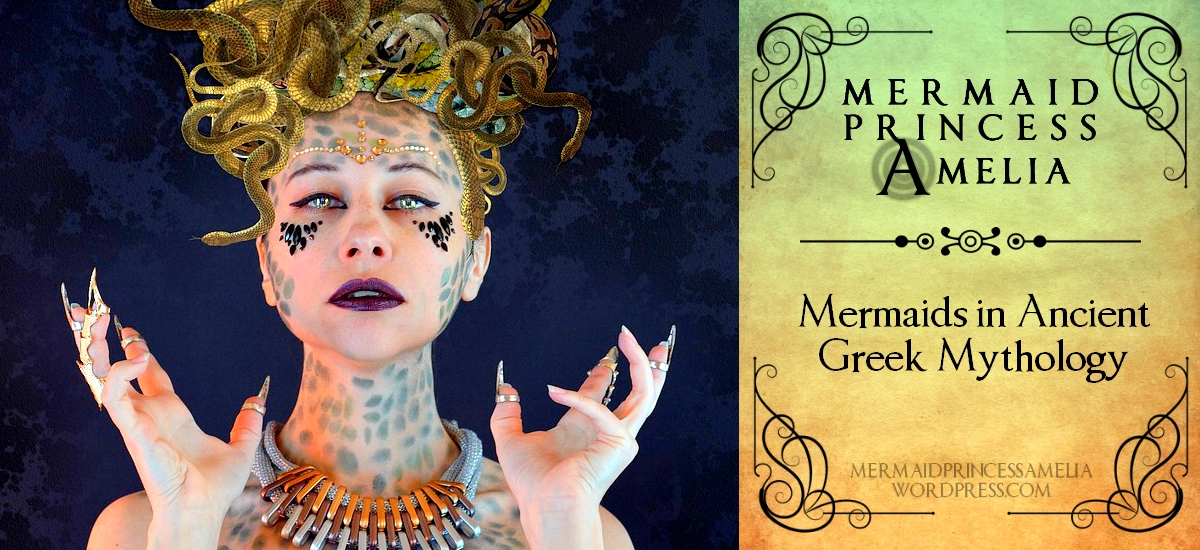
It is worth mentioning though, that the most popular form of mermaids in ancient Greece was that of swift birds with human heads, and that the closest thing in Greek mythology to the most recognized image today is Triton, the god of the seas, the son of Poseidon and Amphitrite, described as a man from the waist up and fish in the rest. Many people also consider Medusa to be a sea creature, because of her name, and the fact that she had snakes instead of her hair.
Still, the greatest enigma linking Greeks and mermaids, is the myth of Atlantis. Atlantis was said to be a gigantic island – some say larger than Libya and Asia Minor combined! – that existed approximately 9000 years before the Athenian lawgiver Solon was born.
In the fictional world of Mermaid Princess Amelia, Atlantis exists and is located outside of the Gibraltar. As for Greek mermaids, they have a controversial reputation. Many label them as inconsiderate, and that is no accident. While other underwater nations feared the possibility of being discovered by humans (o the extent of some nations banning magical practices to avoid drawing attention), Greek mermaids remained oblivious to this. Playful, seductive and mischievous, they lay on rocks, flirting with humans and not hiding their existence at all.
Amelia doesn’t judge them, though. She thinks that if all mermaids had been less fearful and adopted similar attitudes, there would be no need for modern mermaids to hide. They could even help humans with various tasks!
On her journey, Amelia encounters two merpeople from Greece. One is Poseyda Eos, a tall girl with fuchsia eyes, lime-green hair and purple strands, who has a long, lime-green tail. And the other is Jayden Ptolemeus Katharos, a Greek triton with a radiant smile, blue eyes and golden brown hair, a member of a division of volunteer warriors who provide protection to the mermaid princesses during their stay on land.
Related articles:
- 5 friendliest characters from “Mermaid Princess Amelia and the Lost Symphony”
- Atlantis (mermaid kingdom from “Mermaid Princess Amelia and the Lost Symphony”
- Mermaid magic in the “Mermaid Princess Amelia” fantasy series
- Are mermaids and mermen from “Mermaid Princess Amelia” fantasy series beautiful and attractive?
- How to recognize a fellow mermaid on land?

Grab your copy of “Mermaid Princess Amelia and the Lost Symphony” here…
English: https://www.amazon.com/dp/B08T6BJ6RG
Spanish: http://www.amazon.com/gp/product/B08Z8GK1JX
Italian: https://www.amazon.com/dp/B0953PN3Y7
…and join the fanclub! PS: By hitting “Subscribe” you agree to receive newsletters from Maxine Foti:




Leave a Reply