
Mermaid Kingdom of Thai Pearl Empire in “Mermaid Princess Amelia and the Lost Symphony”
The Thai Pearl Empire is a mermaid state located in the Gulf of Thailand. This gulf is actually an inlet of the South China Sea, which is its closest neighbor. It also borders on countries such as Cambodia and Vietnam.
Not much is said about the empire, in the novel. The only merpeople readers get to know about are mostly from the Thani family. Davika is the lady-in-waiting, her mother is the empress, and her aunt Kamon was a famous military strategist, who owned a part of the KAVEM District in Atlantic Ocean, as well. Then, there is also Kamon’s daughter, who’s the current ruler, and Niran – Davika’s older brother.
The artifact of the Gulf of Thailand is a conch brought from the Gulf of Carpentaria. It’s unclear what it was doing there, but perhaps, it was borrowed for some time.
Judging by Davika’s looks, mermaids from the Gulf of Thailand are tanned, with olive green eyes and bright hair. Their tails resemble the Moorish idol.
It seems that the language spoken there, is Thai, as all characters coming from there have Thai names. Davika also greets others with “wai” gesture, pointing to the fact that the customs seen in Thailand, are preserved in the undersea empire, as well.
There are few facts available about the Thai Pearl Empire. However, it is known that they have trade unions with other countries, and are facing an annoying influx of cheap goods from the Coral Sea.
Mermaid Kingdom of Thai Pearl Empire in “Stories from the Undersea World of Mermaid Princess Amelia, Vol. 2”
In Huang Yan’s Story
While less detailed in Huang Yan’s story, the Thai Pearl Empire can be imagined as a realm of exquisite beauty and refinement, mirroring the aesthetics of historical Thai kingdoms but translated into an undersea environment.
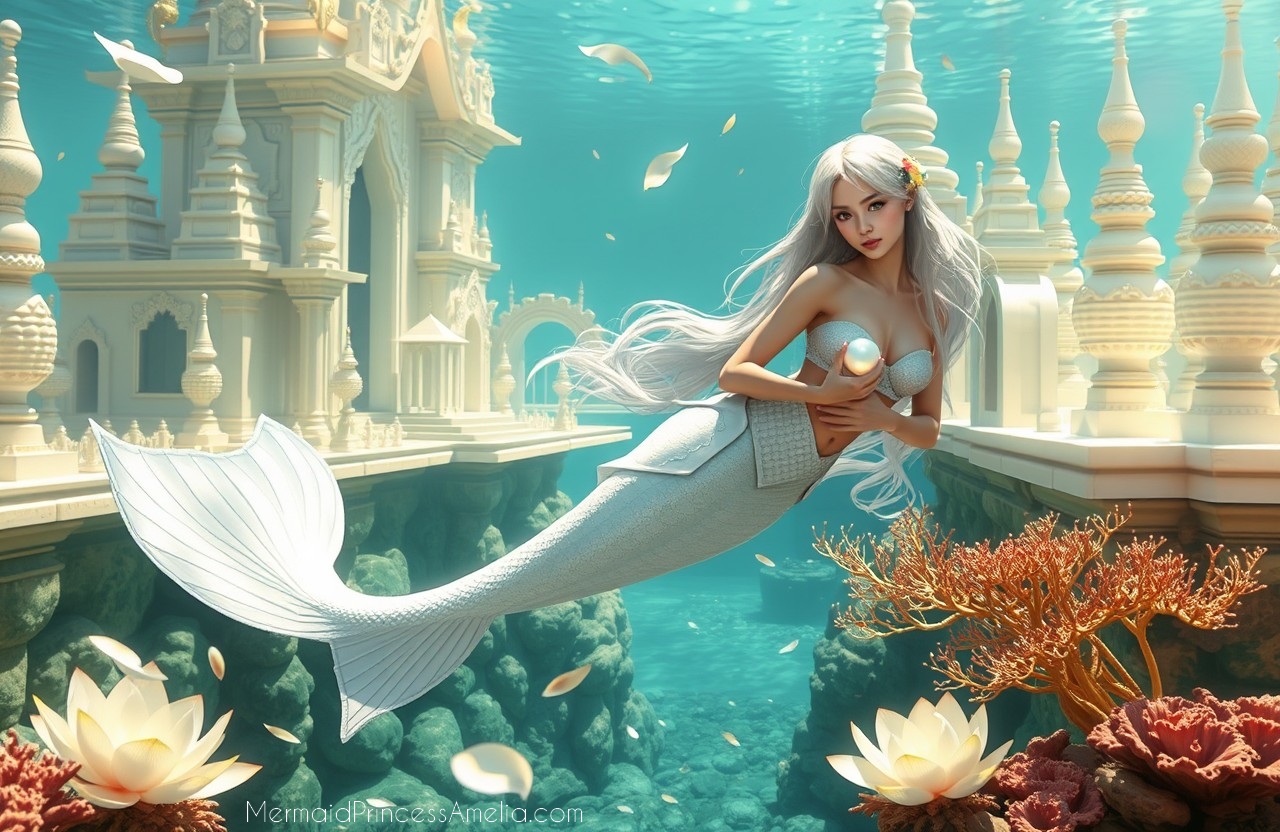
Imagine palaces with sweeping, multi-tiered roofs resembling the prang of Thai temples, but crafted from mother-of-pearl and pink coral.
The architecture would be more ornate and graceful than the sturdy imperial Chinese style of the South China Sea, with spires that reach delicately toward the surface. The kingdom would be famous for its lush, garden-like waters, where pearls of every size and color are cultivated in tranquil oyster beds, and the merpeople are known for their elegant, flowing movements and gentle demeanor.
The overall atmosphere would be one of serene beauty and ancient, peaceful tradition.
In Davika’s Story
The Thai Pearl Empire is a prominent mer-kingdom in Southeast Asian waters, ruled by the Thani family. Its economy and identity are deeply intertwined with the cultivation, trade, and artistry of pearls, which are harvested from oyster farms scattered throughout its territory. This trade generates a steady influx of revenue but also makes the empire a target for economic rivals like the Coral Sea. The empire is a melting pot of diverse religions, including the indigenous Order of Oceanic Enlightenment and Buddhism, which its citizens can practice simultaneously. Socially, there are distinct norms; for instance, mermaids’ tails have larger white stripes with hues of pink, yellow, and green, while mermen’s tails are more colorful, alternating yellow and black. The empire’s relationship with other kingdoms is complex; it is engaged in a relentless economic battle with the Coral Sea, has familial ties being formed with the South China Sea through Wan’s engagement, and maintains a close, friendly bond with the Kingdom of Java and Flores Seas.
Wimalai: The Capital City
Wimalai is the breathtaking, ethereal white capital of the Thai Pearl Empire, renowned as one of the most magnificent underwater destinations. The entire city is constructed in a glistening, celestial white, resembling a “celestial haven on Earth,” with artful glimmers of gold adding a lavish touch. Its splendor is unparallelled, filled with never-ending wonders. The architecture features towering district gates, lotus-bud shaped structures, and buildings covered with intricate bas-reliefs and lace-like carvings. The city is a cultural and spiritual center, housing numerous monastic centers, sacred ancient ruins, and impressive statues. It is a place of both immense beauty and bustling activity, from the grand Whaleport to the unique Net Market.
Wimalai Whaleport
The Whaleport is the main travel hub of the capital, where travelers arrive and depart on the backs of whales. The port has facilities for necessary procedures like immigration, security checks, and health and quarantine protocols. It is a place of constant movement, filled with a “sea of merpeople” coming and going.
Wimalai Net Market
This is a grand edifice and a key commercial center in Wimalai. It is characterized by ivory-white pillars that reach the surface. Unconventionally, it has no walls or floors. Instead, the space is crisscrossed by multiple nets that intertwine to create a mesmerizing labyrinth. The treasures for sale—such as delicate strings of pearls, exquisite sea flower garlands, and robes made from imported sea silk—are suspended upon these nets and showcased at various depths, creating a unique, immersive shopping experience where patrons glide through winding channels to explore the wares.
Wimalai Royal Palace
The royal palace is where the Thani family resides and is Davika’s favorite place in the city. It is made of polished white stone that reflects and multiplies the enchanting light from spherical lamps, creating a truly ethereal atmosphere. The palace complex features covered terraces shielded from view by pearl string curtains that move rhythmically in the water currents. One such terrace contains an “oasis” with an artificial lake made from a partially translucent mirror, surrounded by white corals, pristine sand, and swaying aquatic plants. At its center is a magnificent clam shell that serves as a regal seat. The palace also includes shadowy gardens from which the characters sneak out to attend events like nang yai puppet shows.
Wimalai’s Order of Sea Enlightenment
The Order’s seat is situated in the eastern part of the capital and is central to the local community. Its philosophy, “Sea Enlightenment,” posits that by embracing the wisdom whispered by the sea waters, one can attain spiritual liberation and inner peace. The monks and nuns, called “Eye Opening Precursors,” are respectfully addressed as “Brother” or “Sister” and share the second name “Tale,” from the Thai word for “sea.” They are believed to possess the uncanny ability to communicate with spirits of the deceased, the living, and the unborn through mediumship rituals and divination. The Order’s headquarters have a stunning white exterior covered with white corals, white sea anemones, and white algae. Inside, the ordination hall features an enchanting white facade and immaculate statues of mythical creatures like nagas (half-serpent, half-human deities) and kras (mythical crab-lobsters). A key room within the Order is the “Thought Mine Room,” which contains a dark, foreboding well with a frame casting lights like flower petals, used for deep meditation and psychic endeavors.
Kamon Thani’s Home in Wimalai
Kamon Thani’s private residence is located in the faraway outskirts of Wimalai and reflects her secretive and strategic nature. It is characterized by a tall fence that closes in on the building and its garden, forming a cage-like structure that gives a sense of being trapped. The garden is overgrown with mysterious undersea flora, and the building itself features a traditional chadet thai roof, curved with ornate, filigreed decorations. The windows are deadly quiet, filled with shadows, and partially covered by sea vines. Inside, the living room is rectangular with a tall ceiling and has an atmosphere of stillness and abandonment. It is furnished with a vintage, eerie elegance: a beautifully carved teakwood sofa, an antique brass coffee table, a well-worn carpet, silk floor cushions, and a collection of antique Thai ceramics housing withered plants. At the center is Kamon’s desk, a total mess of papers, with a lamp adorned with hanging capiz shells that sway eerily in the water. The overall impression is of a place reclaimed by nature and haunted by the absence of its owner.
Related articles:
- Davika Thani – a secondary character in “Mermaid Princess Amelia and the Lost Symphony” by Maxine Foti
- Niran Thani – a tertiary character in “Mermaid Princess Amelia and the Lost Symphony” by Maxine Foti
- Kamon Thani – a tertiary character in “Mermaid Princess Amelia and the Lost Symphony” by Maxine Foti
- Learn more about the KAVEM District in the Sargasso Sea
- All artifacts from “Mermaid Princess Amelia and the Lost Symphony” by Maxine Foti

Grab your copy of “Mermaid Princess Amelia and the Lost Symphony” here…
English: https://www.amazon.com/dp/B08T6BJ6RG
Spanish: http://www.amazon.com/gp/product/B08Z8GK1JX
Italian: https://www.amazon.com/dp/B0953PN3Y7
…and join the fanclub! PS: By hitting “Subscribe” you agree to receive newsletters from Maxine Foti:




Leave a Reply