Found by Mermaid Seraphine
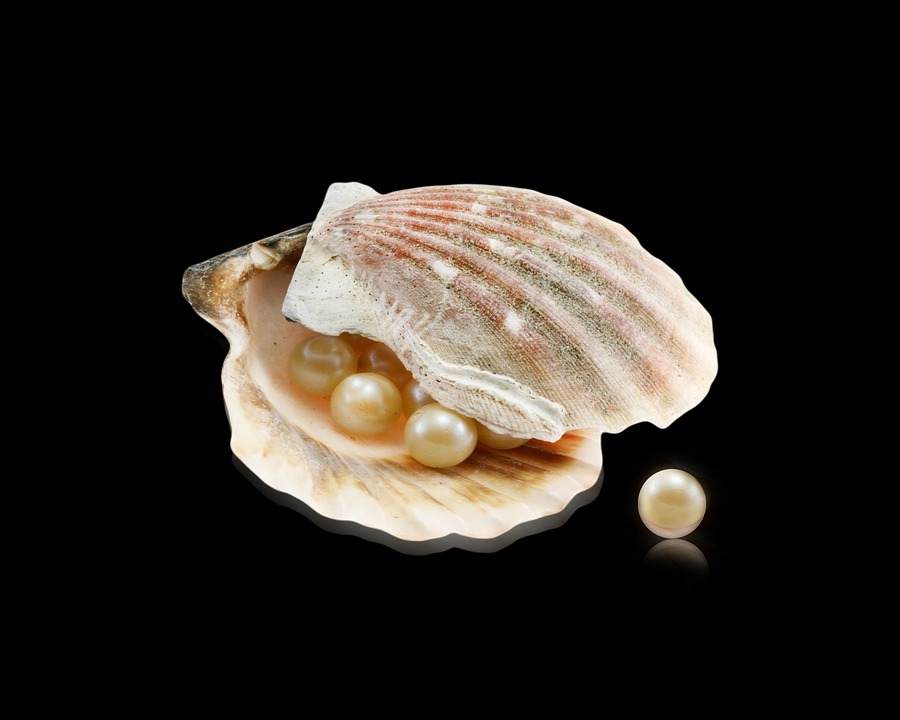
Pearls are symbols of beauty, elegance and luxury. The pearl is considered the most precious gem in the world because it is not made by human hands like other gems. It has been a part of literature for centuries. Today, I’m bringing you my latest finding: A Middle-English Poem titled “The Pearl,” which was translated into modern English by Sophie Jewett. Like all other poems, stories and excerpts published here, it belongs to the public domain. Mermaid Davika from the Thai Pearl Empire would surely love it!
The Pearl – A Middle English Poem – Preface by Sophie Jewett
Among the treasures of the British Museum is a manuscript which contains four anonymous poems, apparently of common authorship: “The Pearl,” “Cleanness,” “Patience,” “Sir Gawayne and the Green Knight.” From the language of the writer, it seems clear that he was a native of some Northwestern district of England, and that he lived in the second half of the Fourteenth Century.
(…) The present translation of “The Pearl” was begun with no larger design than that of turning a few passages into modern English, by way of illustrating to a group of students engaged in reading the original, the possibility of preserving intricate stanzaic form, and something of alliteration, without an entire sacrifice of poetic beauty.
The experiment was persisted in because its problems are such as baffle and fascinate a translator, and the finished version is offered not merely to students of Middle English but to college classes in the history of English literature, and to non-academic readers.
“The Pearl” – Parts 1-5, translated by Sophie Jewett
I
Pearl that the Prince full well might prize,
So surely set in shining gold!
No pearl of Orient with her vies;
To prove her peerless I make bold:
So round, so radiant to mine eyes,
smooth she seemed, so small to hold,
Among all jewels judges wise
Would count her best an hundred fold.
Alas! I lost my pearl of old!
I pine with heart-pain unforgot;
Down through my arbour grass it rolled,
My own pearl, precious, without spot.
Since in that spot it slipped from me
I wait, and wish, and oft complain;
Once it would bid my sorrow flee,
And my fair fortune turn again;
It wounds my heart now ceaselessly,
And burns my breast with bitter pain.
Yet never so sweet a song may be
As, this still hour, steals through my brain,
While verity I muse in vain
How clay should her bright beauty clot;
O Earth! a brave gem thou dost stain,
My own pearl, precious, without spot!
Needs must that spot with spices spread,
Where such wealth falleth to decay;
Fair flowers, golden and blue and red,
Shine in the sunlight day by day;
Nor flower nor fruit have witherèd
On turf wherein such treasure lay;
The blade grows where the grain lies dead,
Else were no ripe wheat stored away;
Of good come good things, so we say,
Then surely such seed faileth not,
But spices spring in sweet array
From my pearl, precious, without spot.
Once, to that spot of which I rhyme,
I entered, in the arbour green,
In August, the high summer-time
When corn is cut with sickles keen;
Upon the mound where my pearl fell,
Tall, shadowing herbs grew bright and sheen,
Gilliflower, ginger and gromwell,
With peonies powdered all between.
As it was lovely to be seen,
So sweet the fragrance there, I wot,
Worthy her dwelling who hath been
My own pearl, precious, without spot.
Upon that spot my hands I crossed
In prayer, for cold at my heart caught,
And sudden sorrow surged and tossed,
Though reason reconcilement sought.
I mourned my pearl, dear beyond cost,
And strange fears with my fancy fought;
My will in wretchedness was lost,
And yet Christ comforted my thought.
Such odours to my sense were brought,
I fell upon that flowery plot,
Sleeping,—a sleep with dreams inwrought
Of my pearl, precious, without spot.
II
From the spot my spirit springs into space,
The while my body sleeping lies;
My ghost is gone in God’s good grace,
Adventuring mid mysteries;
I know not what might be the place,
But I looked where tall cliffs cleave the skies,
Toward a forest I turned my face,
Where ranks of radiant rocks arise.
A man might scarce believe his eyes,
Such gleaming glory was from them sent;
No woven web may men devise
Of half such wondrous beauties blent.
In beauty shone each fair hillside
With crystal cliffs in shining row,
While bright woods everywhere abide,
Their boles as blue as indigo;
Like silver clear the leaves spread wide,
That on each spray thick-quivering grow;
If a flash of light across them glide
With shimmering sheen they gleam and glow;
The gravel on the ground below
Seemed precious pearls of Orient;
The sunbeams did but darkling show
So gloriously those beauties blent.
The beauty of the hills so fair
Made me forget my sufferings;
I breathed fruit fragrance fine and rare,
As if I fed on unseen things;
Brave birds fly through the woodland there,
Of flaming hues, and each one sings;
With their mad mirth may not compare
Cithern nor gayest citole-strings;
For when those bright birds beat their wings,
They sing together, all content;
Keen joy to any man it brings
To hear and see such beauties blent.
So beautiful was all the wood
Where, guided forth by Chance, I strayed,
There is no tongue that fully could
Describe it, though all men essayed.
Onward I walked in merriest mood
Nor any highest hill delayed
My feet. Far through the forest stood
The plain with fairest trees arrayed,
Hedges and slopes and rivers wide,
Like gold thread their banks’ garnishment;
And when I won the waterside,
Dear Lord! what wondrous beauties blent!
The beauties of that stream were steep,
All-radiant banks of beryl bright;
Sweet-sighing did the water sweep,
With murmuring music running light;
Within its bed fair stones lay deep;
As if through glass they glowed, as white
As streaming stars when tired men sleep
Shine in the sky on a winter night.
Pure emerald even the pebbles seemed,
Sapphire, or other gems that lent
Luster, till all the water gleamed
With the glory of such beauties blent.
III
For the beauteousness of downs and dales,
Of wood and water and proud plains,
My joy springs up and my grief quails,
My anguish ends, and all my pains.
A swift stream down the valley hales
My feet along. Bliss brims my brains;
The farther I follow those watery vales,
The stronger joy my heart constrains.
While Fortune fares as her proud will deigns,
Sending solace or sending sore,
When a man her fickle favour gains,
He looketh to have aye more and more.
There was more of marvel and of grace
Than I could tell, howe’er I tried;
The human heart that could embrace
A tenth part were well satisfied;
For Paradise, the very place,
Must be upon that farther side;
The water by a narrow space
Pleasance from pleasance did divide.
Beyond, on some slope undescried
The City stood, I thought, wherefore
I strove to cross the river’s tide,
And ever I longed, yet more and more.
More, and still more wistfully,
The banks beyond the brook I scanned;
If, where I stood, ‘t was fair to see,
Still lovelier lay that farther land.
I sought if any ford might be
Found, up or down, by rock or sand;
But perils plainer appeared to me,
The farther I strode along the strand;
I thought I ought not thus to stand
Timid, with such bright bliss before;
Then a new matter came to hand
That moved my heart yet more and more.
Marvels more and more amaze
My mind beyond that water fair:
From a cliff of crystal, splendid rays,
Reflected, quiver in the air.
At the cliff’s foot a vision stays
My glance, a maiden debonaire,
All glimmering white before my gaze;
And I know her,—have seen her otherwhere.
Like fine gold leaf one cuts with care,
Shone the maiden on the farther shore.
Long time I looked upon her there,
And ever I knew her more and more.
As more and more I scanned her face
And form, when I had found her so,
A glory of gladness filled the place
Beyond all it was wont to show.
My joy would call her and give chase,
But wonder struck my courage low;
I saw her in so strange a place,
The shock turned my heart dull and slow.
But now she lifts that brow aglow,
Like ivory smooth, even as of yore,
It made my senses straying go,
It stung my heart aye more and more.
IV
More than I liked did my fear rise.
Stock still I stood and dared not call;
With lips close shut and watchful eyes,
I stood as quiet as hawk in hall.
I thought her a spirit from the skies;
I doubted what thing might befall;
If to escape me now she tries,
How shall my voice her flight forestall?
Then graciously and gay withal,
In royal robes, so sweet, so slight,
She rose, so modest and so small,
That precious one in pearls bedight.
Pearl bedight full royally,
Adown the bank with merry mien,
Came the maiden, fresh as fleur-de-lys.
Her surcoat linen must have been
Shining in whitest purity,
Slashed at the sides and caught between
With the fairest pearls, it seemed to me,
That ever yet mine eyes had seen;
With large folds falling loose, I ween,
Arrayed with double pearls, her white
Kirtle, of the same linen sheen,
With precious pearls all round was dight.
A crown with pearls bedight, the girl
Was wearing, and no other stone;
High pinnacled of clear white pearl,
Wrought as if pearls to flowers were grown.
No band nor fillet else did furl
The long locks all about her thrown.
Her air demure as duke or earl,
Her hue more white than walrus-bone;
Like sheer gold thread the bright hair strown
Loose on her shoulders, lying light.
Her colour took a deeper tone
With bordering pearls so fair bedight.
Bedight was every hem, and bound,
At wrists, sides, and each aperture,
With pearls the whitest ever found,—
White all her brave investiture;
But a wondrous pearl, a flawless round,
Upon her breast was set full sure;
A man’s mind it might well astound,
And all his wits to madness lure.
I thought that no tongue might endure
Fully to tell of that sweet sight,
So was it perfect, clear and pure,
That precious pearl with pearls bedight.
Bedight in pearls, lest my joy cease,
That lovely one came down the shore;
The gladdest man from here to Greece,
The eagerest, was I, therefore;
She was nearer kin than aunt or niece,
And thus my joy was much the more.
She spoke to me for my soul’s peace,
Courtesied with her quaint woman’s lore,
Caught off the shining crown she wore,
And greeted me with glance alight.
I blessed my birth; my bliss brimmed o’er
To answer her in pearls bedight.
V
“O Pearl,” I said, “in pearls bedight,
Art thou my pearl for which I mourn,
Lamenting all alone at night?
With hidden grief my heart is worn.
Since thou through grass didst slip from sight,
Pensive and pained, I pass forlorn,
And thou livest in a life of light,
A world where enters sin nor scorn.
What fate has hither my jewel borne,
And left me in earth’s strife and stir?
Oh, sweet, since we in twain were torn,
I have been a joyless jeweler.”
That Jewel then with gems besprent
Glanced up at me with eyes of grey,
Put on her pearl crown orient,
And soberly began to say:
“You tell your tale with wrong intent,
Thinking your pearl gone quite away.
Like a jewel within a coffer pent,
In this gracious garden bright and gay,
Your pearl may ever dwell at play,
Where sin nor mourning come to her;
It were a joy to thee alway
Wert thou a gentle jeweler.
“But, Jeweler, if thou dost lose
Thy joy for a gem once dear to thee,
Methinks thou dost thy mind abuse,
Bewildered by a fantasy;
Thou hast lost nothing save a rose
That flowered and failed by life’s decree:
Because the coffer did round it close,
A precious pearl it came to be.
A thief thou hast dubbed thy destiny
That something for nothing gives thee, sir;
Thou blamest thy sorrow’s remedy,
Thou art no grateful jeweler.”
Like jewels did her story fall,
A jewel, every gentle clause;
“Truly,” I said, “thou best of all!
My great distress thy voice withdraws.
I thought my pearl lost past recall,
My jewel shut within earth’s jaws;
But now I shall keep festival,
And dwell with it in bright wood-shaws;
And love my Lord and all His laws,
Who hath brought this bliss. Ah! if I were
Beyond these waves, I should have cause
To be a joyful jeweler.”
“Jeweler,” said that Gem so dear,
“Why jest ye men, so mad ye be?
Three sayings thou hast spoken clear,
And unconsidered were all three;
Their meaning thou canst not come near,
Thy word before thy thought doth flee.
First, thou believest me truly here,
Because with eyes thou mayst me see;
Second, with me in this country
Thou wilt dwell, whatever may deter;
Third, that to cross here thou art free:
That may no joyful jeweler.”
The poem doesn’t end here – it has twenty parts in total. You can read the whole poem on Project Gutenberg.
Related Articles:

Grab your copy of “Mermaid Princess Amelia and the Lost Symphony” here…
English: https://www.amazon.com/dp/B08T6BJ6RG
Spanish: http://www.amazon.com/gp/product/B08Z8GK1JX
Italian: https://www.amazon.com/dp/B0953PN3Y7
…and join the fanclub! PS: By hitting “Subscribe” you agree to receive newsletters from Maxine Foti:

Leave a Reply